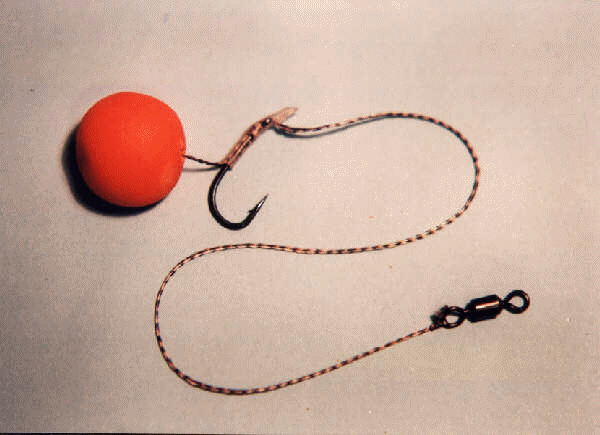
Also you may on occasions find you need a small weight to take the bait down faster. place this bait about 6 inches from the hook. If you have a bait that will rise in the water you can also use this same method to pop up the bait a little way off the bottom.
Floating bread is a popular way to catch carp and big roach during the hot weather. A larger hook (barbless) is needed to hold the bread as smaller hooks tend to pull out to easily. Take a piece of crusty bread and cast to chosen spot, this is usually not to far from bank. It is not always necessary to see the fish feeding on top before you try this method larger fish will often lurk in deeper water only to appear when taking the bread. This really is a thrill for the angler akin to fly fishing.
Get to know the water you intend to fish.
The most important part of consistently catching big carp is watercraft. Getting to know the waters you fish is part of watercraft , you might see some person who always catches the lions share of fish. Don't look at him and think lucky person (or whatever ?!!?) . For if he is lucky he will have to wait a long time for more luck. Chances are this person has experience of the water. You might ask yourself what advantage this person has over you ? After all you are both casting a line into the water so you "must" have an equal chance?????? The thing to remember in any given lake or river the fish are NOT evenly spread throughout . If you have ever looked in a fish aquarium you will see that if there is any kind of feature , the fish will stay close because they will feel safe . Some features like fallen trees are obvious places to fish and well worth a look but these places often become "fished-out" due to fishing pressure . Out in a lake there are hundreds of "features " where the fish feel safe . There are not many lakes or rivers that have a perfectly uniform bottom or bank side. So without using diving apparatus how do we look for these
Plumbing the depth.
I always plumb the depth. Use a spare rod set with a 2-3 oz lead (sinker) attached to the line by a free running barrel swivel . Then put a bead on the line . At the end of the line tie a large buoyant float (bobber) The lead is free running on the line until it comes to the end where the bead and float is .
( Therefore when cast out then wind in until i feel the float hit the lead on the bottom. So keeping a fairly tight line , let out the line a foot at a time, counting until the float comes up. For every foot of line you let off the reel , the float will rise a foot , so its just a simple case of keeping count of the feet . On my plumbing rod I have a piece of tape near the first eye which measures exactly one foot. So its just a simple case of loosening the clutch and pulling off the line to the tape . If you have this set up correctly it is accurate to at least three inches
The depth of water .
The depth of water you are fishing in is very important. Fish will be at various depths according to weather conditions. By gaining experience you will be able to "follow" the fish as conditions change , therefore making consistent catches . The plumbing rod can tell you of sharp changes of depth out in the lake. Normally when gravel is extracted from lakes , the method used creates long strips of gravel which are like banked seating at a football stadium . These are called gravel bars . These are excellent places to fish as not only do the fish feel safe but food tends to collect at the bottom of these bars. The fish tend to use these bars to travel around a lake in the same way we follow a motorway (interstate) . Most of the time these bar`s are invisible (being underwater) By finding the change in depth you are well on your way to finding a "HOT SPOT" all of your own. Then other people might start calling you lucky! But you will know better!
Bottom Texture.
The depth is not the only important thing the plumb rod can tell you. With experience you tell what sort of bottom you are fishing in. How is that important you might ask. Well carp just like humans have favorite places to eat. Sometimes the softer (silty) bottoms contain all sorts of goodies for the fish to eat . The technique of feeling along the bottom with rod and line is something where practice is needed. You have to use a heavy lead (sinker) of at least 2oz so keeping a tight line between rod and lead. You cast out the lead and pull it along the bottom with the rod at right angles to the water. You can "feel" the lead through the rod . When you are over gravel , the tip will ping and stutter as if you are dragging it over a jagged rock (which you are) You will find the lead has lots of marks in it , this is a sure sign of a gravel bottom. Where as with a soft bottom the lead would have sunk in so takes a bit of effort to get it out but you can feel its like pulling the lead through sludge (which it is) With a sandy type bottom you will find it will be harder than the silty bottom so the lead wont sink in so far . You will find it a smooth steady pull with a consistent resistance. When fishing waters with lots of weed in them it pays to try and find clear areas near the weed as there is a good chance(if they are the same depth as the weed) that they are kept clear by moving and feeding fish . I had one of my best catches ever by finding a small clear area next to lots of weed . Knowing the bottom also lets you plan what size of hook lengths to use. I wouldn't feel very confident fishing short hook lengths in a deep soft bottom like silt.


 Fishing techniques